


Leadtek NVIDIA RTX 5000 Ada 32GB GDDR6 With ECC WorkStation Graphics Card
900-5G132-2540-000
Out of stock
Leadtek NVIDIA RTX 5000 Ada 32GB GDDR6 With ECC WorkStation Graphics Card
900-5G132-2540-000
- Brand: Leadtek
- MPN: 126V5000100
- Part #: VGALTK05010
- UPC:


- Brand: Leadtek
- MPN: 126V5000100
- Part #: VGALTK05010
- UPC:
Product is out of stock. View similar products in-stock at PB Tech


Features
NVIDIA RTX 5000 Ada Generation
- Ada Lovelace GPU architecture
- 32GB GDDR6 Memory with ECC
- Max. Power Consumption: 250W
- Graphics Bus: PCI-E 4.0 x16
- Thermal Solution: Active
- Display Connectors: DP 1.4a (4)
- Support NVIDIA vGPU software
- Compatible with Quadro Sync II
Performance for Endless Possibilities
Industries are embracing accelerated computing and AI to tackle powerful dynamics and unlock transformative possibilities. Generative AI is reshaping the way professionals create and innovate across various domains, from design and engineering to entertainment and healthcare. The NVIDIA RTX™ 5000 Ada Generation, with third-generation RTX technology, unlocks breakthroughs in generative AI, revolutionizing productivity and offering unprecedented creative possibilities.
The NVIDIA RTX 5000 Ada Generation is purpose-built for today's professional workflows. Built on the NVIDIA Ada Lovelace architecture, it combines 100 third-generation RT Cores, 400 fourth-generation Tensor Cores, and 12,800 CUDA® cores with 32GB of graphics memory to accelerate rendering, AI, graphics, and compute workloads. RTX 5000-powered workstations equip you for success in today's demanding business landscape.
Performance Features
NVIDIA Ada Lovelace Architecture
NVIDIA RTX™ 5000 Ada Generation is the most balanced workstation GPU offering high-performance, real-time ray tracing, AI-accelerated compute, and professional graphics rendering within an optimized power envelope. Building upon the major SM enhancements from the Ada Lovelace GPU, the NVIDIA Ada Lovelace architecture enhances ray tracing operations, tensor matrix operations, and concurrent executions of FP32 and INT32 operations.
NVIDIA CUDA Cores
The NVIDIA Ada Lovelace architecture-based CUDA cores bring up to 2X the single-precision floating point (FP32) throughput compared to the previous generation, providing significant performance improvements for graphics workflows such as 3D model development and compute for workloads such as desktop simulation for computer-aided engineering (CAE). The RTX 5000 enables two FP32 primary data paths, doubling the peak FP32 operations.
Third-Generation RT Cores
Incorporating 3rd generation ray tracing engines, NVIDIA Ada Lovelace architecture-based GPUs provide incredible ray traced rendering performance. A single RTX 5000 board can render complex professional models with physically accurate shadows, reflections, and refractions to empower users with instant insight. Working in concert with applications leveraging APIs such as NVIDIA OptiX, Microsoft DXR and Vulkan ray tracing, systems based on the RTX 5000 will power truly interactive design workflows to provide immediate feedback for unprecedented levels of productivity. The RTX 5000 is up to 2X faster in ray tracing compared to the previous generation. This technology also speeds up the rendering of ray-traced motion blur for faster results with greater visual accuracy.
Fourth-Generation Tensor Cores
Purpose-built for deep learning matrix arithmetic at the heart of neural network training and inferencing functions, the RTX 5000 includes enhanced Tensor Cores that accelerate more datatypes and includes a new Fine-Grained Structured Sparsity feature that delivers up to 5X throughput for tensor matrix operations compared to the previous generation Tensor Cores. New Tensor Cores will accelerate two new TF32 and BFloat16 precision modes. Independent floating-point and integer data paths allow more efficient execution of workloads using a mix of computation and addressing calculations.
Higher Speed GDDR6 Memory
Built with 32GB GDDR6 memory, the RTX 5000 delivers the memory throughput required for memory intensive tasks such as ray tracing, rendering, and AI workloads. The RTX 5000 provides large graphics memory to address the larger datasets and models in latency-sensitive professional applications.
PCIe Gen 4
The RTX 5000 supports PCI Express Gen 4, which provides double the bandwidth of PCIe Gen 3, improving data-transfer speeds from CPU memory for data-intensive tasks like AI and data science.
Error Correcting Code (ECC) on Graphics Memory
Meet strict data integrity requirements for mission-critical applications with uncompromised computing accuracy and reliability for workstations.
5th Generation NVDEC Engine[1]
NVDEC is well suited for transcoding and video playback applications for real-time decoding. The following video codecs are supported for hardware-accelerated decoding: MPEG-2, VC-1, H.264 (AVCHD), H.265 (HEVC), VP8, VP9, and AV1 video formats. Video encoding at 8K/60 will be achievable for professional video editing.
8th Generation NVENC Engine
NVENC can take on the most demanding 4K or 8K video encoding tasks to free up the graphics engine and the CPU for other operations. The RTX 5000 provides better encoding quality than software-based x264 encoders. The RTX 5000 incorporate AV1 video encoding which is 40% more efficient than H.264 encoding for 4K HDR video. AV1 will provide better quality at the same bitrate bandwidth.
Graphics Preemption
Pixel-level preemption provides more granular control to better support time-sensitive tasks such as VR motion tracking.
Compute Preemption
Preemption at the instruction level provides finer-grain control over compute tasks to prevent long-running applications from either monopolizing system resources or timing out.
RTX IO
Accelerating GPU-based lossless decompression performance by up to 100x and 20x lower CPU utilization compared to traditional storage APIs using Microsoft's new DirectStorage for Windows API. RTX IO moves data from the storage to the GPU in a more efficient, compressed form, and improving I/O performance.
Multi-GPU Technology
NVIDIA® SLI® Technology
Leverage multiple GPUs to dynamically scale graphics performance, enhance image quality, expand display real estate, and assemble a fully virtualized system.
Display Features
NVIDIA Mosaic Technology
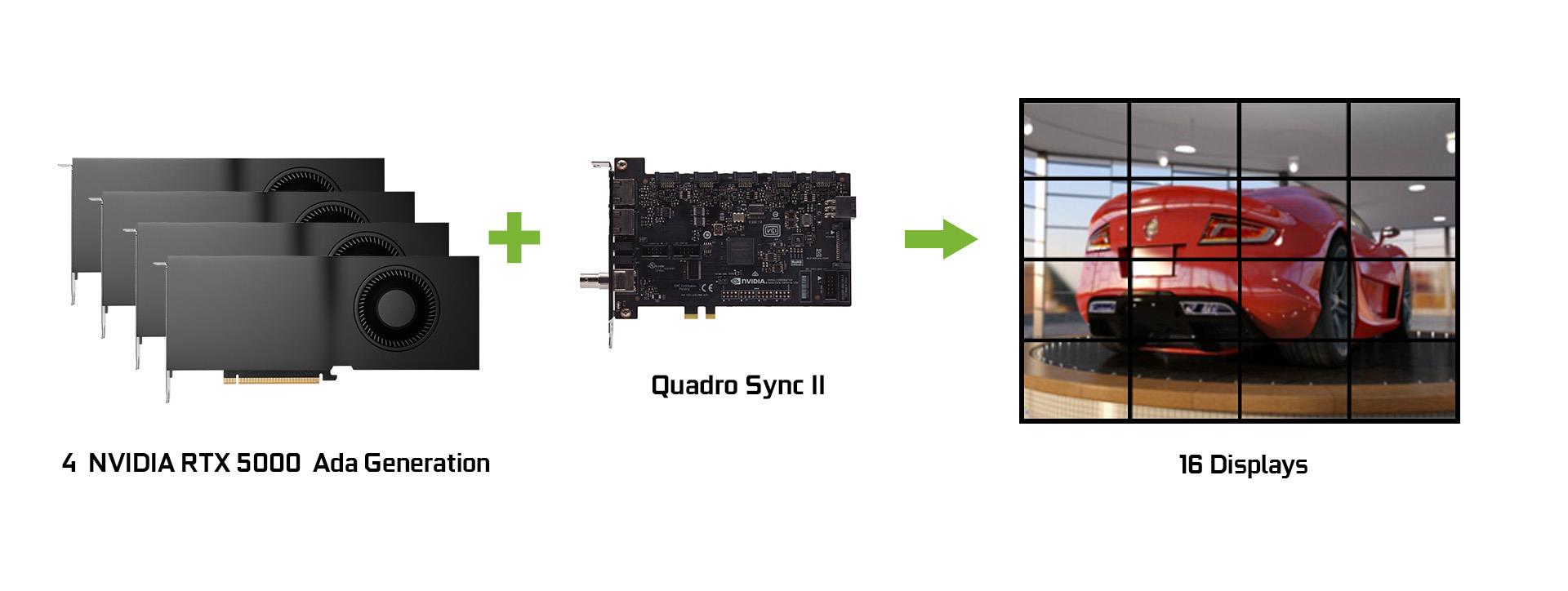
Transparently scale the desktop and applications across up to 4 GPUs and 16 displays from a single workstation while delivering full performance and image quality.
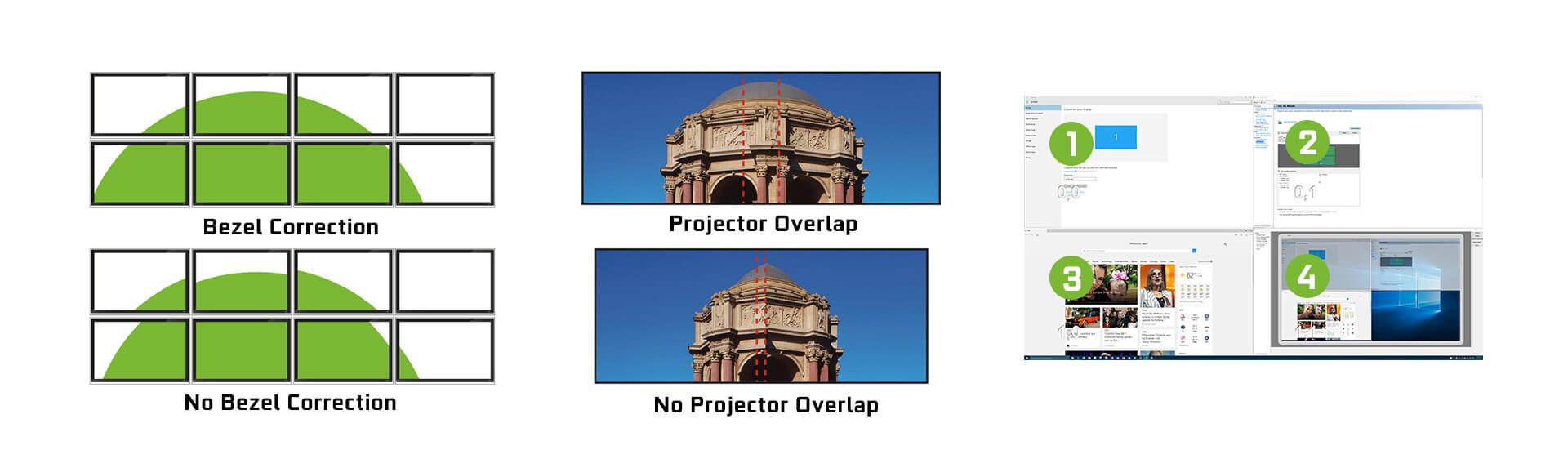
DisplayPort 1.4a
Support up to four 5K monitors @ 60Hz, or dual 8K displays @ 60Hz per card. The RTX 5000 supports HDR color for 4K @ 60Hz for 10/12b HEVC decode and up to 4K @ 60Hz for 10b HEVC encode. Each DisplayPort connector can drive ultra-high resolutions of 4096x2160 @ 120 Hz with 30-bit color.
NVIDIA RTX™ Desktop Manager
Gain unprecedented end-user control of the desktop experience for increased productivity in a single large display or multi-display environments, especially in the current age of large, widescreen displays.
NVIDIA Quadro Sync II
Synchronize the display and image output of up to 32 displays[2] from 8 GPUs (connected through two Sync II boards) in a single system, reducing the number of machines needed to create an advanced video visualization environment.
Frame Lock Connector Latch
Each frame lock connector is designed with a self-locking retention mechanism to secure its connection with the frame lock cable to provide robust connectivity and maximum productivity.
OpenGL Quad Buffered Stereo Support
Provide a smooth and immersive 3D Stereo experience for professional applications.
Ultra-High-Resolution Desktop Support
Get more Mosaic topology choices with high resolution displays devices with a 32K Max desktop size.
Professional 3D Stereo Synchronization
Robust control of stereo effects through a dedicated connection to directly synchronize 3D stereo hardware to an NVIDIA RTX professional graphics card.
Software Support
NVIDIA Virtual GPU Software[3]
Support for NVIDIA virtual GPU (vGPU) software allows a personal workstation to be repurposed into multiple high-performance virtual workstation instances enabling remote users to share resources to drive high-end design, AI, and compute workloads.
NVIDIA® RTX™ Experience
NVIDIA RTX Experience delivers a suite of productivity tools to your desktop workstation, including desktop recording in up to 8K, automatic alerts for the latest NVIDIA RTX Enterprise driver updates, and access gaming features.
Software Optimized for AI
Deep learning frameworks such as Caffe2, MXNet, CNTK, TensorFlow, and others deliver dramatically faster training times and higher multi-node training performance. GPU accelerated libraries such as cuDNN, cuBLAS, and TensorRT delivers higher performance for both deep learning inference and High-Performance Computing (HPC) applications.
NVIDIA® CUDA® Parallel Computing Platform
Natively execute standard programming languages like C/C++ and Fortran, and APIs such as OpenCL, OpenACC and Direct Compute to accelerates techniques such as ray tracing, video and image processing, and computation fluid dynamics.
Unified Memory
A single, seamless 49-bit virtual address space allows for the transparent migration of data between the full allocation of CPU and GPU memory.
NVIDIA GPUDirect® for Video
GPUDirect for Video speeds communication between the GPU and video I/O devices by avoiding unnecessary system memory copies and CPU overhead.
NVIDIA Enterprise-Management Tools
Maximize system uptime, seamlessly manage wide-scale deployments and remotely control graphics and display settings for efficient operations.
1 This feature requires implementation by software applications, and it is not a stand-alone utility.
2 Support requires Linux and NVIDIA RTX Enterprise Driver R387 or newer. NVIDIA SLI Certified System required for over 4 GPUs.
3 Virtualization support for the RTX 5000 Ada Generation will be available in an upcoming NVIDIA virtual GPU (vGPU) release, anticipated in Q3, 2023.
Specifications
Reviews
Accessories


Delivery & Pick-up

Delivery Estimates
The estimated time to ship for each product we sell is detailed on the individual product page just underneath the price. From when your items ship, products typically arrive within 1-2 working days for North Island deliveries and 2-3 working days for South Island deliveries. Rural deliveries may take an extra working day. Bulk & hazard deliveries may take an extra 2-7 working days.
Next Day Delivery
Need your order in a hurry? PB Tech offers next day delivery for local Auckland addresses. Simple place your order before 4pm (provided your items are in stock) and select our next day delivery option in the checkout. T&C's apply. Learn more about Next Day Delivery.
Same Day Delivery
Need your order in a hurry? PB Tech offers same day delivery for Auckland, Hamilton, Wellington and Christchurch. Simple place your order before 1pm (provided your items are in stock) and select one of our same day delivery options 'Evening Delivery' or 'Urgent 3-hour Delivery' in the checkout. T&C's apply. Learn more about Same Day Delivery.
Shipping Costs
Shipping costs vary based on your location and the items being shipped and in some cases shipping may even be FREE.
To calculate what the shipping costs will be for your order, add the items you are interested in to your cart, view the Shopping Cart page, and select your 'Delivery Area' to calculate the shipping cost.
Shipping Security & Insurance
All orders shipped by PB Tech are sent via a courier with a signature required for each delivery. In some cases, and only where you have given the courier company permission to leave orders at a designated location, your order may be delivered without requiring a signature. All orders sent by PB Tech are fully insured in the unlikely event that your item(s) are damaged or go missing in transit.
1 Hour Store Pick-up / Click & Collect
You can pick-up your online order from any of our stores nationwide. You can select which store you want to pick up from at the checkout. Provided the store you select has stock and there's no hold-ups with payment we will have your order ready within 1 hour (during normal trading hours for that store) otherwise it may take up to 5 working days to transfer the stock to the store so your order can be fulfilled. Learn more about our Click & Collect process.
Overseas Shipments
PB Tech regularly ships overseas to Australia and beyond. If you are located in Australia, you can order directly from our Australian site www.pbtech.com/au. If you are from another country you can order from www.pbtech.com
Returns & Warranty
Related Promotions


Popular Workstation Graphics Cards

 NVIDIA RTX PRO 6000 Blackwell 96GB Workstation Edition Graphics...

 NVIDIA RTX A400 4GB Professional Workstation Graphics Card PCIe 4...

 NVIDIA RTX PRO 4000 Blackwell 24GB Graphics Card

 NVIDIA RTX A1000 8GB GDDR6 WorkStation Graphics Card 4x Mini...

 NVIDIA RTX PRO 2000 Blackwell 16GB Graphics Card


Leadtek NVIDIA RTX 5000 Ada 32GB GDDR6 With ECC WorkStation Graphics Card 900-5G132-2540-000
- Brand: Leadtek
- MPN: 126V5000100
- Part #: VGALTK05010
Product URL: https://www.pbtech.co.nz/product/VGALTK05010/Leadtek-NVIDIA-RTX-5000-Ada-32GB-GDDR6-With-ECC-Wo
| Branch | New Stock | On Display |
|---|---|---|
| Auckland - Albany | 0 | |
| Auckland - Glenfield | 0 | |
| Auckland - Queen Street | 0 | |
| Auckland - Auckland Uni | 0 | |
| Auckland - Westgate | 0 | |
| Auckland - Penrose | 0 | |
| Auckland - Henderson (Express) | 0 | |
| Auckland - St Lukes | 0 | |
| Auckland - Manukau | 0 | |
| Hamilton | 0 | |
| Tauranga | 0 | |
| New Plymouth | 0 | |
| Palmerston North | 0 | |
| Petone | 0 | |
| Wellington | 0 | |
| Auckland - Head Office | 0 | |
| Auckland - East Tamaki Warehouse | 0 | |
| Christchurch - Hornby | 0 | |
| Christchurch - Christchurch Central | 0 | |
| Dunedin | 0 |
Features
NVIDIA RTX 5000 Ada Generation
- Ada Lovelace GPU architecture
- 32GB GDDR6 Memory with ECC
- Max. Power Consumption: 250W
- Graphics Bus: PCI-E 4.0 x16
- Thermal Solution: Active
- Display Connectors: DP 1.4a (4)
- Support NVIDIA vGPU software
- Compatible with Quadro Sync II
Performance for Endless Possibilities
Industries are embracing accelerated computing and AI to tackle powerful dynamics and unlock transformative possibilities. Generative AI is reshaping the way professionals create and innovate across various domains, from design and engineering to entertainment and healthcare. The NVIDIA RTX™ 5000 Ada Generation, with third-generation RTX technology, unlocks breakthroughs in generative AI, revolutionizing productivity and offering unprecedented creative possibilities.
The NVIDIA RTX 5000 Ada Generation is purpose-built for today's professional workflows. Built on the NVIDIA Ada Lovelace architecture, it combines 100 third-generation RT Cores, 400 fourth-generation Tensor Cores, and 12,800 CUDA® cores with 32GB of graphics memory to accelerate rendering, AI, graphics, and compute workloads. RTX 5000-powered workstations equip you for success in today's demanding business landscape.
Performance Features
NVIDIA Ada Lovelace Architecture
NVIDIA RTX™ 5000 Ada Generation is the most balanced workstation GPU offering high-performance, real-time ray tracing, AI-accelerated compute, and professional graphics rendering within an optimized power envelope. Building upon the major SM enhancements from the Ada Lovelace GPU, the NVIDIA Ada Lovelace architecture enhances ray tracing operations, tensor matrix operations, and concurrent executions of FP32 and INT32 operations.
NVIDIA CUDA Cores
The NVIDIA Ada Lovelace architecture-based CUDA cores bring up to 2X the single-precision floating point (FP32) throughput compared to the previous generation, providing significant performance improvements for graphics workflows such as 3D model development and compute for workloads such as desktop simulation for computer-aided engineering (CAE). The RTX 5000 enables two FP32 primary data paths, doubling the peak FP32 operations.
Third-Generation RT Cores
Incorporating 3rd generation ray tracing engines, NVIDIA Ada Lovelace architecture-based GPUs provide incredible ray traced rendering performance. A single RTX 5000 board can render complex professional models with physically accurate shadows, reflections, and refractions to empower users with instant insight. Working in concert with applications leveraging APIs such as NVIDIA OptiX, Microsoft DXR and Vulkan ray tracing, systems based on the RTX 5000 will power truly interactive design workflows to provide immediate feedback for unprecedented levels of productivity. The RTX 5000 is up to 2X faster in ray tracing compared to the previous generation. This technology also speeds up the rendering of ray-traced motion blur for faster results with greater visual accuracy.
Fourth-Generation Tensor Cores
Purpose-built for deep learning matrix arithmetic at the heart of neural network training and inferencing functions, the RTX 5000 includes enhanced Tensor Cores that accelerate more datatypes and includes a new Fine-Grained Structured Sparsity feature that delivers up to 5X throughput for tensor matrix operations compared to the previous generation Tensor Cores. New Tensor Cores will accelerate two new TF32 and BFloat16 precision modes. Independent floating-point and integer data paths allow more efficient execution of workloads using a mix of computation and addressing calculations.
Higher Speed GDDR6 Memory
Built with 32GB GDDR6 memory, the RTX 5000 delivers the memory throughput required for memory intensive tasks such as ray tracing, rendering, and AI workloads. The RTX 5000 provides large graphics memory to address the larger datasets and models in latency-sensitive professional applications.
PCIe Gen 4
The RTX 5000 supports PCI Express Gen 4, which provides double the bandwidth of PCIe Gen 3, improving data-transfer speeds from CPU memory for data-intensive tasks like AI and data science.
Error Correcting Code (ECC) on Graphics Memory
Meet strict data integrity requirements for mission-critical applications with uncompromised computing accuracy and reliability for workstations.
5th Generation NVDEC Engine[1]
NVDEC is well suited for transcoding and video playback applications for real-time decoding. The following video codecs are supported for hardware-accelerated decoding: MPEG-2, VC-1, H.264 (AVCHD), H.265 (HEVC), VP8, VP9, and AV1 video formats. Video encoding at 8K/60 will be achievable for professional video editing.
8th Generation NVENC Engine
NVENC can take on the most demanding 4K or 8K video encoding tasks to free up the graphics engine and the CPU for other operations. The RTX 5000 provides better encoding quality than software-based x264 encoders. The RTX 5000 incorporate AV1 video encoding which is 40% more efficient than H.264 encoding for 4K HDR video. AV1 will provide better quality at the same bitrate bandwidth.
Graphics Preemption
Pixel-level preemption provides more granular control to better support time-sensitive tasks such as VR motion tracking.
Compute Preemption
Preemption at the instruction level provides finer-grain control over compute tasks to prevent long-running applications from either monopolizing system resources or timing out.
RTX IO
Accelerating GPU-based lossless decompression performance by up to 100x and 20x lower CPU utilization compared to traditional storage APIs using Microsoft's new DirectStorage for Windows API. RTX IO moves data from the storage to the GPU in a more efficient, compressed form, and improving I/O performance.
Multi-GPU Technology
NVIDIA® SLI® Technology
Leverage multiple GPUs to dynamically scale graphics performance, enhance image quality, expand display real estate, and assemble a fully virtualized system.
Display Features
NVIDIA Mosaic Technology
Transparently scale the desktop and applications across up to 4 GPUs and 16 displays from a single workstation while delivering full performance and image quality.
DisplayPort 1.4a
Support up to four 5K monitors @ 60Hz, or dual 8K displays @ 60Hz per card. The RTX 5000 supports HDR color for 4K @ 60Hz for 10/12b HEVC decode and up to 4K @ 60Hz for 10b HEVC encode. Each DisplayPort connector can drive ultra-high resolutions of 4096x2160 @ 120 Hz with 30-bit color.
NVIDIA RTX™ Desktop Manager
Gain unprecedented end-user control of the desktop experience for increased productivity in a single large display or multi-display environments, especially in the current age of large, widescreen displays.
NVIDIA Quadro Sync II
Synchronize the display and image output of up to 32 displays[2] from 8 GPUs (connected through two Sync II boards) in a single system, reducing the number of machines needed to create an advanced video visualization environment.
Frame Lock Connector Latch
Each frame lock connector is designed with a self-locking retention mechanism to secure its connection with the frame lock cable to provide robust connectivity and maximum productivity.
OpenGL Quad Buffered Stereo Support
Provide a smooth and immersive 3D Stereo experience for professional applications.
Ultra-High-Resolution Desktop Support
Get more Mosaic topology choices with high resolution displays devices with a 32K Max desktop size.
Professional 3D Stereo Synchronization
Robust control of stereo effects through a dedicated connection to directly synchronize 3D stereo hardware to an NVIDIA RTX professional graphics card.
Software Support
NVIDIA Virtual GPU Software[3]
Support for NVIDIA virtual GPU (vGPU) software allows a personal workstation to be repurposed into multiple high-performance virtual workstation instances enabling remote users to share resources to drive high-end design, AI, and compute workloads.
NVIDIA® RTX™ Experience
NVIDIA RTX Experience delivers a suite of productivity tools to your desktop workstation, including desktop recording in up to 8K, automatic alerts for the latest NVIDIA RTX Enterprise driver updates, and access gaming features.
Software Optimized for AI
Deep learning frameworks such as Caffe2, MXNet, CNTK, TensorFlow, and others deliver dramatically faster training times and higher multi-node training performance. GPU accelerated libraries such as cuDNN, cuBLAS, and TensorRT delivers higher performance for both deep learning inference and High-Performance Computing (HPC) applications.
NVIDIA® CUDA® Parallel Computing Platform
Natively execute standard programming languages like C/C++ and Fortran, and APIs such as OpenCL, OpenACC and Direct Compute to accelerates techniques such as ray tracing, video and image processing, and computation fluid dynamics.
Unified Memory
A single, seamless 49-bit virtual address space allows for the transparent migration of data between the full allocation of CPU and GPU memory.
NVIDIA GPUDirect® for Video
GPUDirect for Video speeds communication between the GPU and video I/O devices by avoiding unnecessary system memory copies and CPU overhead.
NVIDIA Enterprise-Management Tools
Maximize system uptime, seamlessly manage wide-scale deployments and remotely control graphics and display settings for efficient operations.
1 This feature requires implementation by software applications, and it is not a stand-alone utility.
2 Support requires Linux and NVIDIA RTX Enterprise Driver R387 or newer. NVIDIA SLI Certified System required for over 4 GPUs.
3 Virtualization support for the RTX 5000 Ada Generation will be available in an upcoming NVIDIA virtual GPU (vGPU) release, anticipated in Q3, 2023.
Specifications
GPU Architecture
NVIDIA Ada Lovelace Architecture
CUDA Cores
12800
Tensor Cores
400
RT Cores
100
Single-Precision Performance[1]
65.3 TFLOPS
RT Core Performance[1]
151.0 TFLOPS
Tensor Performance[1]
1044.4 TFLOPS[2]
GPU Memory
32 GB GDDR6 with ECC
Memory Interface
256-bit
Memory Bandwidth
576 GB/s
Max Power Consumption
250W
Graphics Bus
PCI Express 4.0 x16
Display Connectors
DP 1.4a (4)[3]
Form Factor
4.4" H x 10.5" L Dual Slot
Product Weight
1079.7g
Thermal Solution
Blower Active Fan
vGPU Software Support[3]
NVIDIA® Virtual PC/Virtual Applications (vPC/vApps), NVIDIA RTX Virtual Workstation (vWS)
vGPU Profiles Supported
1GB, 2 GB, 3 GB, 4 GB, 6 GB, 8 GB, 12 GB, 16 GB, 24 GB
NVIDIA® 3D Vision® and 3D Vision Pro
Support via 3 pin mini DIN
Frame Lock
Compatible (with Quadro Sync II)
NVLink Interconnect
Not Supported
Power Connector
1x 16-pin CEM5 PCIe
NVENC | NVDEC
2x | 2x (+AV1 encode & decode)
Notes
[1]Peak rates are based on GPU boost clock.
[2]Effective FP8 TFLOPS using the new sparsity feature.
[3]Display ports are on by default for the RTX 5000 Ada Generation. Display ports are not active when using vGPU software. Virtualization support for the RTX 5000 Ada Generation will be available in an upcoming NVIDIA virtual GPU (vGPU) release, anticipated in Q3, 2023.


